When Balidaan Becomes Dharam: NLP Insights from Dhurandhar (Chapter 4)

When Balidaan Becomes Dharam: NLP Insights from Dhurandhar (Chapter 4)

Lights! Camera! NLP! · The Dhurandhar Arc, Chapter 4 of 10.

Previously, we read the line that names the fuel. Dard turning into endhan. The wound converted into mission. Today, we lift our gaze to the crest of the Para Special Forces, and find an NLP model carved into a metal badge.

(For the full arc, visit Lights! Camera! NLP!.)


On the crest of the Para Special Forces, one word burns.

“Balidaan.”

[Sacrifice.]

And the phrase they live by, older than the regiment itself, reads:

“Balidaan Parmo Dharam.”

[Sacrifice is the highest duty.]

Stop. Read it again.

Not “sacrifice is required.” Not “sacrifice is noble.”

Sacrifice is the highest DUTY. Dharam. The thing at the top of the order, above every other loyalty, every other desire, every other plan.

This is NLP Logical Levels, carved on a metal badge.


The Ladder

In NLP, Robert Dilts gave us a simple but powerful model. Human experience stacks across six levels.

The lower levels deal with “where” and “what” and “how.” The higher levels deal with “who” and “for what.”

Change at a lower level rarely holds. Try to change a habit at Behaviour and it slides back in few days. Change at a higher level re-organises everything below it.

The dhurandhar does not perform sacrifice. He operates from a level where sacrifice is simply what the work asks. Identity and Mission are doing the heavy lifting. The behaviour follows quietly.


The Same Act, Six Different Weights

Take one act. Burning a family photograph.

At Environment, it is a ritual.

At Behaviour, it is an act.

At Capability, it is a skill in emotion management.

At Beliefs, it is betrayal.

At Identity, it is cover.

At Mission, it is dharam.

Same flame. Six different readings. Only the last one is sustainable over a long operation.

This is what NLP calls a level-shift reframe. When you meet someone drowning in the pain of a decision, you don’t argue with the pain. You gently move the decision up one or two Logical Levels. Suddenly the same act has a different weight.

A friend came to me once who had been trying to quit smoking for ten years. Patches. Apps. New routines. New friends. He had tried everything.

I asked him what level he was running this change at.

He paused. Behaviour, he said. Maybe Capability.

That’s the problem, I told him. Your Behaviour is being asked to do all the work, while your Identity is still sitting at “I am a smoker who is trying to quit.”

We changed exactly one thing. We moved the work up to Identity.

“Main non-smoker hoon. Aaj. Hamesha.”

[I am a non-smoker. Today. Always.]

Within a week, the patches were gone. Within a month, the cravings had become something he simply observed and let pass.

Same person. New rung on the ladder. Everything below it had quietly re-organised itself.

That is what level-shift reframing does, on the small balidaans. Now imagine what it does on the big ones.


Dharam Is Not Drama

There is a trap here.

Balidaan romanticised is no longer balidaan. It is performance.

The true dhurandhar is quiet about the price. Not because he is stoic. Because the Mission is doing what Mission does. It absorbs the cost without needing applause.

The Para SF crest doesn’t say “look at what we sacrificed.” It just says Balidaan. That is the tone.

A senior leader walked into a corporate workshop I was running on Leadership Lessons from Dhurandhar. He was respected, accomplished, well-liked.

But every time he spoke, a particular pattern surfaced. He kept reminding everyone of what he had given up. Family time, traded for the business. Health, traded for the quarterly numbers. Hobbies abandoned, sleep cut, weekends sacrificed.

I waited for a quieter moment, and then I told him, gently. Sir, what you are describing is not balidaan.

He looked surprised.

The reminders, I said. The fact that you are still telling us, in this room, ten years later, what you gave up. That is the tell.

Balidaan, when it is real, does not need an audience.

Honestly, this is a check I keep running on myself, too. There are moments when I catch myself naming what I have given up for the work, and the moment I do, I know exactly which level I have slid down to. The reminder is the tell. Always.

Awareness widens choices.


The Line On Your Crest

You are probably not going to be asked to enter a foreign country under a new name.

But you are going to be asked, this week, to choose between something easy and something right. Between convenience and a commitment. Between your comfort and someone else’s need. Between short-term gain and the person you said you would become.

Each of those is a small balidaan, sitting quietly on the table, waiting to be picked up.

The question NLP asks you is not, “are you willing to sacrifice?”

The question is: at what Logical Level are you making the choice?

From Environment, you will feel cheated.

From Identity, you will feel aligned.

From Mission/Purpose, you will feel free.

Same act. Very different internal experience.


Three Questions

1. What is the dharam of your current chapter? Not the job title. The dharam.

2. Which small balidaans are you still resisting, because you are making the call from too low a level?

And the hardest one:

3. If Balidaan Parmo Dharam were the only line on your own crest, would your diary this week honour it?

That third question, taken seriously, can rearrange your habitat.

But rearranging is the work.

Till the time we meet next, stay cinematic, and keep the curiosity alive.


Tomorrow.

Chapter 5 of the Dhurandhar Arc. Climbing the Ladder.

Level by level, the transformation of Jaskirat into Hamza. And the one rung that does not change.

Make sure to subscribe to receive all updates from W3 Coach directly in your inbox.

https://w3coach.com/subscribe/


Discover the Magic in the Mundane by subscribing to the Weekly Newsletter - NLP Around You.

Explore the complete set of online recorded courses at W3 Success Academy now.

Dard Aur Endhan: NLP Insights from Dhurandhar (Chapter 3)

Dard Aur Endhan: NLP Insights from Dhurandhar (Chapter 3)

Lights! Camera! NLP! · The Dhurandhar Arc, Chapter 3 of 10.

Previously, we walked through the three NLP pillars hidden inside one line that Sanyal whispered to Jaskirat. Nazar, Sabr, Raaj. Today, we sit with a different line. The one that names the rarer ingredient. The fuel that turns a wound into a mission.

(For the full arc, visit Lights! Camera! NLP!.)


There is a line in the film that stopped me in the theatre.

“Badla lena aasan nahi hota. Dard ko hausle ka endhan chahiye hota hai. Aur woh endhan har kisi ke pass nahi hota.”

[Revenge is never easy. Pain needs the fuel of courage. And not everyone possesses that fuel.]

Pause.

Read it again.

Pain Is Common. Endhan Is Rare.

Pain is common. Endhan is rare.

Everyone has a wound. Very few have the fuel to convert the wound into a mission.

In NLP, we call this a Motivation Strategy. The internal sequence that takes you from felt state to decisive action. Picture, self-talk, feeling, in a specific order, at a specific intensity, linking trigger to movement.

Most people have pain. Very few have the strategy. The gap between knowing and doing opens exactly here.

Some see the picture of their wound and collapse into it. The picture gets bigger, louder, closer. They sit inside it for years.

Some see the picture and numb. Over food, over drink, over scrolling, over busyness.

Honestly, we are all a little guilty here. Scroll a little. Stay busy a lot. Modern life has made numbing the default response, and we hardly notice it any more.

And then there is a third response. The dhurandhar’s response.

He sees the wound. He hears the insult. He feels the grief. And at the very moment the feeling peaks, something inside him says:

“Yeh dard kahin ja raha hai.”

[This pain is going somewhere.]

The picture reframes from victim to mission. The feeling converts into resolve.

That conversion is the endhan.

A senior leader once raised her hand in a corporate workshop I was running on Leadership Lessons from Dhurandhar. She said she had not been able to find motivation. For three years now.

I asked what had happened three years ago.

A long pause. Then, softly. Divorce.

There is a lot of pain there, I told her. But where is the endhan?

She looked unsure.

Dard is something we all have, I said. The question isn’t whether it exists. The question is what you are doing with it. Aapne usko ek tank mein bhar rakha hai, andar. Tank bhar gaya hai. Lekin engine tak nahi pahuncha.

[You have stored the pain in a tank inside yourself. The tank is full. But it has not reached the engine.]

Conversion has to be taught. Hardly anyone teaches it.

Pain we all have.

Endhan, almost no one has been taught to build.


Built, Not Given

Two things about this endhan.

First, it has to be built. Nobody is born with a motivation strategy this clean. The dhurandhar has rehearsed his internal film a thousand times. Every setback. Every slight. Every loss. Processed, repurposed, anchored to movement. Years before any mission brief is ever signed.

Second, it has to be chosen. You can sit with pain forever. You can drink with pain forever. You can blame, scroll, sulk, lecture, post. Each of those is also a motivation strategy. Just one that moves you sideways instead of forward.


Away-From and Toward

NLP splits motivation into two meta-programs. Away-from. And Toward.

Both work. But the dhurandhar runs a hybrid. Away-from the wound. Toward the outcome. One without the other is half an engine.

Away-from alone, you run hard for a while and then stall. Because the wound is behind you now. The push is gone.

Toward alone, you wander. Because nothing inside you is pushing you forward.

The dhurandhar carries both. The dard is the push. The mission is the pull. Together, they make endhan.

A senior executive came to me one afternoon. Driven. Sharp. Already operating at the top of his game.

He said the goals were getting achieved. But there was a weight on his chest. Always.

I asked him a single question. Whom are you running from? For the past twenty years?

A long silence.

Then, softly. From my father, sir. He was very tough. Even today, his voice runs through my head.

Your away-from is clear, I said. Very clear.

But what is your toward? What are you actually building?

That is when he went quiet.

This is the half-engine. You can run from your dard for two decades. But unless you also know what you are running toward, the engine never finishes its work.

The endhan stays incomplete.

The chest stays heavy.


Three Questions

Now hold this up to your own life.

1. Which wound are you sitting inside, instead of converting?

2. What would it take to reframe that wound as endhan [fuel]?

And the hardest one:

3. Who would I need to become to turn this pain into propulsion, instead of letting it turn me into ash?

That third question, asked honestly, can take a quiet evening and a cup of chai to answer.

But quiet evenings are where endhan gets built.

Endhan is not given. It is built, strike by strike, day by day. Long before the revenge, long before the mission, long before anyone is watching.

That is why not everyone has it.

That is what makes a dhurandhar.

Till the time we meet next, stay cinematic, and keep the curiosity alive.


Tomorrow.

Chapter 4 of the Dhurandhar Arc. When Balidaan Becomes Dharam.

On the crest of the Para Special Forces, one word burns. And underneath it, an NLP model carved into metal.

Make sure to subscribe to receive all updates from W3 Coach directly in your inbox.

https://w3coach.com/subscribe/


Discover the Magic in the Mundane by subscribing to the Weekly Newsletter - NLP Around You.

Explore the complete set of online recorded courses at W3 Success Academy now.

Nazar, Sabr, Raaj: NLP Insights from Dhurandhar (Chapter 2)

Nazar, Sabr, Raaj: NLP Insights from Dhurandhar (Chapter 2)

Lights! Camera! NLP! · The Dhurandhar Arc, Chapter 2 of 10.

Previously, we sat with Jaskirat as he declared his values hierarchy out loud, and then watched him pay every cost that hierarchy demanded. Today, we listen in on the line Sanyal whispers to him about the three deadliest weapons of the trade.

(For the full arc, visit Lights! Camera! NLP!.)


There is a sentence inside Dhurandhar that sounds like tradecraft. It is something else.

Listen to this line carefully.

“Hamaare peshe mein sabse ghatak auzar hai Nazar aur Sabr. Dono ki dhaar hamesha tez rakhna. Tumhara uddeshya sirf Pakistan mein ghusna hi nahi, poore jangal pe raaj karna hai.”

[In our profession, the deadliest weapons are vision and patience. Keep both blades sharp at all times. Your aim is not just to enter Pakistan. Your aim is to rule the entire jungle.]

Three weapons, in three Hindi words.

NLP teaches the same three, in three English ones.

1. Sensory Awareness.

2. Behavioural Flexibility.

3. Outcome Orientation.

The three pillars that hold up every well-lived life, every brilliant mission, every honest relationship.

Sanyal is not giving tradecraft. He is giving NLP, in Hindi.


Nazar: Sensory Awareness

Nazar is not just looking. Nazar is calibrated looking.

The micro-twitch before the lie. The breath that holds a beat too long. The smile that doesn’t reach the eyes. The room that just got colder without anyone touching the thermostat.

Most of us walk through a day with our nazar switched off. Phone in hand. Thoughts loud. The world is sending us signals we never receive.

Honestly, we are all a little guilty here. Pick up the phone, scroll for two minutes, and the entire mauhol of the meeting slips past unnoticed. In modern life, nazar dulling has become the default setting.

The dhurandhar cannot afford that. One missed signal, one dead agent. One missed twitch, one blown cover.

NLP calls this Sensory Acuity. The refusal to import your conclusions before you have gathered the evidence.

Sharp nazar makes everything else possible.

A senior leader once sat with me in a corporate workshop on Leadership Lessons from Dhurandhar. Sharp, accomplished, fully present in the room.

Before the next break, I gave him just one task. For the next thirty minutes, observe his team. No deciding. No fixing. No coaching. Only nazar.

He came back from the break visibly different.

“Sir, mujhe pata hi nahi tha meri team kaise feel kar rahi hai. Pichhle saal main poori team ko miss kar diya.”

[Sir, I had no idea how my team was actually feeling. I have missed my entire team for the past year.]

That is what nazar lets you see. Not new information. Information that was always there, just never received.


Sabr: Behavioural Flexibility

You might expect sabr to mean patience. It does. But watch what patience makes possible.

Patience gives you the time to try something different when the first thing didn’t work. And the second. And the seventh.

NLP calls this Behavioural Flexibility. The Law of Requisite Variety says the element in any system with the most flexibility controls the system.

The amateur tries approach A. It fails. He argues with reality.

The dhurandhar tries approach A. It fails. He tries B. B fails. He tries C. He does not confuse the setback with the outcome. He just stays in the game long enough to find the move that works.

A client came to me one afternoon, frustrated. He said he had tried an approach. It didn’t work.

I asked him how many times he had tried.

He said, once.

Once.

I told him, sabr is not about waiting. Sabr is about agar A ne kaam nahi kiya, toh B karte hain. B nahi chala, toh C. Aur D. Aur G.

[If A doesn’t work, we try B. If B doesn’t work, then C. And D. And G.]

Until you find the one that does.

Sabr is the refusal to quit the table before the right hand is dealt.

Most plans don’t fail because the plan was wrong. They fail because the planner ran out of patience before the plan could run out of options.


Raaj: Outcome Orientation

“Sirf Pakistan mein ghusna hi nahi. Poore jangal pe raaj karna hai.”

[Not just to enter Pakistan. To rule the entire jungle.]

This is the single most important sentence in the film, for our purposes.

Because most people stop at ghusna. Enter the course. Enter the role. Enter the marriage. Enter the business. Enter, and survive.

The dhurandhar is trained to think in jungle-raaj terms.

Not just enter the market. Own the category.

Not just finish the MBA. Reshape how your industry thinks.

Not just build the business. Build the thing the next generation copies.

NLP calls this a well-formed outcome. Specific. Positive. Under your control. Ecological. And above all, worthy. Big enough to mobilise the dard within. Big enough to keep you flexible when plan A dies on the runway.

Ghusna is survival. Raaj is purpose.

A senior executive I worked with for years was bahut driven. Every quarter, fresh goals. Specific, time-bound, perfectly written.

Three months in, he came to me with a quiet confession. The goals were getting achieved. But andar se khaali lagta tha. [Inside, it felt empty.]

I asked him one question.

“Aapke goals ghusna goals hain ya raaj goals?”

[Are your goals about merely entering, or about ruling?]

He sat with that for a long time.

The amateur plans for ghusna and wonders why he feels flat three months in.

The dhurandhar plans for raaj and wonders why everyone else is settling.


The Three, Together

Nazar without outcome is just being observant. You notice everything and build nothing.

Outcome without flexibility is just being stubborn. You want the kingdom and break yourself trying the same door.

Flexibility without nazar is just being busy. You try many things without reading which one is working.

The three, sharp together, are the dhurandhar’s edge. In any field.

Ask yourself today:

1. Where is your nazar dulling, because your phone is louder than the room?

2. Where has your sabr quit, because plan A felt good and plan C felt like defeat?

And the hardest one:

3. Are you planning for ghusna, when your life was built for raaj?

That third question, when answered honestly, can make some people sit up at their desks.

But sitting up is the work.

Till the time we meet next, stay cinematic, and keep the curiosity alive.


Tomorrow.

Chapter 3 of the Dhurandhar Arc. Dard Aur Endhan.

Pain is common. The fuel that converts pain into mission is rare.

Make sure to subscribe to receive all updates from W3 Coach directly in your inbox.

https://w3coach.com/subscribe/


Discover the Magic in the Mundane by subscribing to the Weekly Newsletter - NLP Around You.

Explore the complete set of online recorded courses at W3 Success Academy now.

Iss Janam, Agle Janam: NLP Insights from Dhurandhar (Chapter 1)

Iss Janam, Agle Janam: NLP Insights from Dhurandhar (Chapter 1)

“Picture nahi dekha to kya seekha…”

[If you don’t watch movies, what have you really learned?]

That was an oft-repeated quote from one of my professors in college. And it always resonated with the movie-buff within me.

5th December 2025 and then 19th March 2026. Two dates that got marked in my calendar for the First Day First Show of “Dhurandhar” and “Dhurandhar: The Revenge” respectively.

A lot has been said on the net and on Instagram (which almost turned into Dhurangram) about the movie, the music, the peak detailing, the brilliant twists and reveals, even the propaganda agenda.

Well, now it’s time to look at the films through a different lens.

My favourite lens.

The NLP Lens.

So, as Hamza says:

“Agar tum logon ke patakhe khatam ho gaye ho, toh main dhamaka shuru karu!”

[If your firecrackers are done, shall I begin the explosion?]

Let’s dive in…


“Dhurandhar” is not a name. It is a title.

In old Hindi and Sanskrit, a dhurandhar is one who carries the load. The expert. The champion. The one the rest of the pack leans on. Aditya Dhar’s two-part epic uses the word with full intention. The hero is not a man with a gun. He is a man with a burden.

And Dhurandhar: The Revenge adds the second half of the equation. Because what makes a master a master is not how he fights. It is what he does after he is wounded.

This is where NLP walks in.

Ten Chapters. Ten Layers.

Aditya Dhar didn’t make one film. He made two. And he didn’t write a story. He structured a curriculum. A spy thriller as a study in state management, identity, and the long pause.

The Dhurandhar films are chapter-wise. Each chapter peels one layer of the dhurandhar’s craft.

This series will mirror that. Ten chapters. Ten days. One craft.

One a day. Each post one chapter. Each chapter one layer beneath the surface peak-detailing.

Let’s begin with the value beneath the man.


Chapter 1: Iss Janam, Agle Janam

Jaskirat joined the army. But the army was not his first love. He tells Pinda, in a back-story scene that hits harder than any action sequence:

“Iss janam mein family first yaara. Agle janam mein desh ko bhi sambhal lunga.”

[In this life, family first, my friend. In the next life, I’ll take care of the country too.]

Read that twice. It is not just a dialogue. It is a values hierarchy, declared out loud.

In NLP, Values represent what is important to you. What you move toward. What you move away from. The invisible command line of your life, running under every decision.

And Jaskirat has just named his top value. Family. Everything else sits below.

When twelve men shatter his family, he goes after them. Alone. Using the very army training he swore to honour, to dismantle them. Twelve lives. One by one.

He knows what it costs. His uniform, gone. His career, gone.

He chooses anyway. Because a man lives the hierarchy he announces.

The trouble, of course, is that most of us announce one hierarchy and live another. The values we name for the brochure rarely match the values we run on the calendar.

A senior banker once sat across from me in a workshop, sharp and polished and accomplished. I asked him his top values. He answered without pausing. Family. Integrity. Growth. Contribution.

I said, beautiful. Now pull out your calendar. Last three months.

Family, four percent of his time. Integrity, a concept on a wall, not a calendar slot. Growth, meeting after meeting after meeting. Contribution, LinkedIn posts.

Stated values, perfect on paper.

Lived values, an entirely different list, hidden in the calendar.

A man’s hierarchy is not in his speeches. It is in his diary.

For most of Jaskirat’s life, the top of his diary held just one word. Family. Until a new word arrived to be written above it.


Re-ranking the Architecture of the Heart

Then Sanyal walks in. Operation Dhurandhar. A mission that needs a man with nothing left to lose.

We watch Jaskirat burn a photograph of his family.

In NLP language, this is a values shift at the level of identity. Not a new behaviour. A new hierarchy. Country, for the first time in his life, moves to the top of the pile. Not because he stopped loving family. Because he has built a new family: the mission, the handler, the nation.

The photograph doesn’t burn out of hatred. It burns because he has to re-rank the architecture of his own heart.

Years later, in a Karachi home, Yalina. A son. A life that began as cover, and became real.

Then the mission ends.

We watch him burn another photograph.

This is where the film stops being a thriller and becomes a tragedy. Because the values conflict is no longer between family and country. It is between two families. The one he was born into. The one he built in the dark.

Two meta-values. Both legitimate. Both alive. Both demanding everything.

There is no clean answer. Only a choice. And a cost.


When You Cannot Quite Come Home

And then the quiet scene. He returns home to Punjab.

His own family. The one the mission promised he would come back to.

And he cannot quite fit back in.

Because the man who left is not the man who returned. And no one in that room knows what he became, what he buried, what he carried across a border and burnt in a tin.

This is values work at the most painful edge. When you live long enough by a new hierarchy, you cannot simply reverse it. You carry the cost of every earlier version of you.

Your values don’t sit on a wall as a corporate poster.

They run as code. Silently. Constantly.

Every time you say yes, every time you say no, your values are choosing for you.

The Jaskirat tragedy is not that he chose. It is that, for a long time, he did not notice the choice was happening.

Awareness widens choices. When you know your hierarchy, you can question it. Protect it. Re-rank it consciously. When you don’t, it runs you.

A client wrote to me late one night, after a corporate workshop I had run that day. The theme had been Leadership Lessons from Dhurandhar. We had walked together through the same scenes you are reading now, including the moment Jaskirat burns the photograph.

Eleven o’clock, the kind of message that arrives only when the day has gone quiet enough for honesty.

He had carried the question home. Which photograph am I quietly burning, in my own life?

The answers came back slowly, he said. His health. His sleep. His marriage. The books he had never finished. All of it, on the same fire, all of it in the name of growth.

Then he wrote one more line.

“Sir, yahi awareness hai na, jo choices ko widen karti hai?”

[Sir, this awareness, isn’t it the one that widens choices?]

Yes. Exactly that one.

Ask yourself today:

1. What is my current top-three values hierarchy, in real terms, not Instagram terms?

2. Is there a photograph I am quietly burning in some corner of my life, without naming the cost?

And the hardest one:

3. If someone watched only my calendar and my bank statement for 90 days, what would they conclude my top value actually is?

The answer to that third question can actually shake some people up.

Till the time we meet next, stay cinematic, and keep the curiosity alive.


Tomorrow.

Chapter 2 of the Dhurandhar Arc. Nazar, Sabr, Raaj.

Three words that turn out to be three of NLP’s most foundational pillars.


Make sure to subscribe to receive all updates from W3 Coach directly in your inbox.

https://w3coach.com/subscribe/


Discover the Magic in the Mundane by subscribing to the Weekly Newsletter - NLP Around You.
Explore the complete set of online recorded courses at W3 Success Academy now.

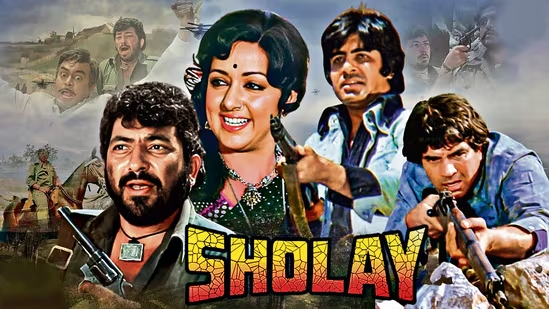
When Sholay Failed First and Won Forever

When Sholay Failed First and Won Forever

When Sholay Failed First and Won Forever

An NLP Lens on Rejection, Reframing, and Resilience

This week, Sholay returned to the big screen and something remarkable happened.

Audiences did not just watch the film.

They relived it.

Laughter erupted at familiar lines. Silence fell in scenes people already knew by heart. Applause broke out without prompting. It felt less like a re-release and more like a reunion.

Yet, rewind exactly 50 years to 1975.

Before Sholay became a super mega hit, before it turned into a cultural scripture quoted across generations, it faced strong criticism from reviewers. I recently revisited one such newspaper review from its original release, and reading it today is a fascinating psychological experience.

Because almost everything that was criticised then…

is exactly what made Sholay immortal.

Here is the review which actually criticised and even ridiculed the movie Sholay when it was released in 1975

https://w3coach.com/let-your-work-speak-for-you/

Let us look at this through an NLP lens. From an NLP perspective, Sholay offers a masterclass in how meaning is not fixed. Meaning is constructed.

The Map Is Not the Territory

One of NLP’s foundational principles is this: the map is not the territory.

Critics in 1975 were responding to their maps of what cinema should look like at that time. They were comparing Sholay to existing frames of reference. Song structures. Story arcs. Moral binaries. Duration norms.

But Sholay was not trying to fit an old map.

It was quietly creating a new territory.

Audiences sensed it before critics did. Over time, that new territory became the benchmark.

A powerful reminder for leaders, creators, and professionals: rejection often says more about the observer’s map than your actual territory.

Chunking and the Problem of Perspective

Many early reviews criticised Sholay for its length and episodic feel. From an NLP lens, this is a classic chunking mismatch.

At a micro level, the film felt indulgent.

At a macro level, it was mythic.

When you chunk up, Sholay is not just a story of two friends versus a villain. It is about loyalty, loss, moral ambiguity, fear, courage, humour in despair, and friendship that survives death.

Great work often fails when judged at the wrong level of chunking.

In organisations, I see this often. A long-term vision criticised for short-term discomfort. A leader labelled impractical because the observer is chunked too low.

Anchoring and Emotional Imprints

Today, the background score of Sholay is enough to trigger an emotional state. Gabbar’s dialogues have become anchors etched into collective memory. Jai’s silence. Veeru’s desperation. Thakur’s restraint.

But anchors do not always fire instantly.

Sometimes, the nervous system of a society needs time to wire new emotional associations. What feels unfamiliar today becomes iconic tomorrow.

This is true for ideas, brands, and identities.

If your work does not get instant validation, it does not mean it lacks impact. It may simply be ahead of the current emotional conditioning.

Reframing Failure as Feedback

NLP never treats failure as final. It treats it as feedback.

The initial criticism of Sholay did not erase the film. It refined the audience. Over time, people reframed what they were watching. What once felt excessive began to feel expansive.

The film did not change.

The frame did.

And that is perhaps the most liberating insight here.

You do not always need to change your content. Sometimes, the world just needs time to update its frame.

Fifty Years Later

Watching Sholay today, alongside that 1975 review, is a reminder that legacy is not decided in the first week, the first review, or the first response.

Legacy is decided by resonance over time.

And from an NLP lens, Sholay proves one timeless truth:

“Meaning is never fixed. It is constructed.”

And occasionally, history reframes what criticism could not.

That, perhaps, is Sholay’s greatest lesson beyond cinema.


A Lesson Beyond Cinema

Sholay is no longer just a film. It is proof that delayed recognition is still recognition. That criticism is not prophecy. That meaning evolves.

In NLP, we say: people respond to meaning, not reality.

In 1975, the meaning assigned to Sholay was limited.

In 2025, the meaning is legendary.

The difference was never the film.

The difference was the frame.

And that is the difference that truly makes the difference.

Image credit: Hindustan Times

Make sure to subscribe to receive all updates from W3 Coach directly in your inbox.

https://w3coach.com/subscribe/


Discover the Magic in the Mundane by subscribing to the Weekly Newsletter - NLP Around You.

Explore the complete set of online recorded courses at W3 Success Academy now.

Zindagi Na Milegi Dobaara: An NLP Lens on a Film That Mirrors Us Back

Zindagi Na Milegi Dobaara: An NLP Lens on a Film That Mirrors Us Back

Today is 2–12.

Do-baara.

A date that whispers a simple reminder: life always gives you another chance, if you’re willing to take it.

And there couldn’t be a better day to revisit the film that turned “seize the moment” into a lived philosophy: Zindagi Na Milegi Dobaara.

But today, let’s watch it through a different lens:

Your NLP lens, the inner movie that runs beneath the outer movie.

The Film We All Watched v/s The Inner Film We All Lived.

ZNMD wasn’t just a road trip.

It was an inner trip, like an NLP workshop disguised as a Bollywood blockbuster.

Three friends set out on holiday, but each one is actually escaping:

  • Arjun is escaping his past.
  • Imran is escaping his truth.
  • Kabir is escaping his future.

Look closely and you’ll notice:

Every character is stuck not in circumstances, but in internal representations – the images, sounds, meanings and emotional anchors they have unconsciously built over years.

Just like us.

1. Arjun: The Prison of Old Anchors

Arjun’s life runs on one dominant anchor:

“Work gives me safety.”

But safety for him isn’t a feeling — it’s a compulsion.

His internal representation of life is a tight frame:

Work → Money → Control → Certainty.

When Laila asks him, “Tum kaam kab karte ho aur jeete kab ho?”,

she is doing a classic Meta Model challenge by questioning his rigid linguistic distortions.

She breaks his pattern so he can breathe again.

His transformation is essentially a state change:

From tight, rushed, urgent to open, relaxed, trusting.

Breathwork in the skydiving scene is literal, but it’s also metaphoric:

Sometimes the only way out of fear is through the body, not the mind.

2. Imran: The Rewrite of Meaning

Imran hides pain behind humour, which is a perfect example of dissociation.

He speaks in sarcasm so he never has to speak his truth.

When he meets his father, that one conversation reframes his identity.

Not externally, but internally.

This is reframing at its finest:

Same father.

Same absence.

New meaning.

What was once “He didn’t want me” becomes

“He couldn’t give me what I expected.”

And that’s not the same thing.

A shift in meaning creates a shift in the entire story.

That is exactly what NLP does.

3. Kabir: The Conflict of Parts

Kabir is the perfect case study for Parts Integration.

One part of him genuinely loves Natasha.

Another part of him wants freedom.

One part is fulfilling a promise.

Another part is terrified of losing himself.

He doesn’t need advice.

He needs alignment.

And it happens when he finally listens to the part that has been whispering the truth all along.

ZNMD shows beautifully that clarity rarely comes from others.

It comes when your inner parts stop fighting and start collaborating.

4. The Spain Trip: A Spatial Anchor for Transformation

Every city becomes an anchor:

  • Costa Brava stands for Fun.

This is where the boys finally loosen up, take their first big leap into deep-sea diving and meet Laila, who gently nudges them out of their seriousness. It is the place where their guardedness dissolves and the trip truly begins.

  • Seville stands for Expression.

Here they step into the world of Flamenco, poetry, honest conversations and emotional unmasking. Arjun softens, Imran confronts his truth and Kabir begins to face his dilemma, all in a city that celebrates openness and passion.

  • Pamplona stands for Courage.

The Running of the Bulls forces each of them to stop running from themselves. It becomes the moment where fear meets action, where clarity becomes commitment and where their inner shifts turn into bold choices.

Environment shifts state.

State shifts choices.

Choices shift life.

The landscape changes them because a change in space leads to a change in inner stories.

This is why travelling often feels therapeutic.

It’s NLP’s spatial anchoring working quietly in the background.

So What Is the NLP Lesson of ZNMD?

Simple:

Life changes the moment your inner movie changes.

Arjun changed his pace.

Imran changed his meaning.

Kabir changed his choices.

The outer world moved only after the inner world shifted.

And that’s the magic of NLP.

It hands you the remote control of your mind, so that you can direct the film you truly want to live.

A Gentle Reminder Today (2-12, Dobaara)

You do not get another life.

But you do get another chance.

A chance to reinterpret, to realign, to re-anchor, to re-choose.

Every fear can be re-scripted.

Every belief can be re-framed.

Every identity can be re-written.

Every past can be re-perceived.

And every moment offers you a “Dobaara” – if you’re willing to press “Play” again.

Make sure to subscribe to receive all updates from W3 Coach directly in your inbox.

https://w3coach.com/subscribe/


Discover the Magic in the Mundane by subscribing to the Weekly Newsletter - NLP Around You.

Explore the complete set of online recorded courses at W3 Success Academy now.

Pin It on Pinterest