
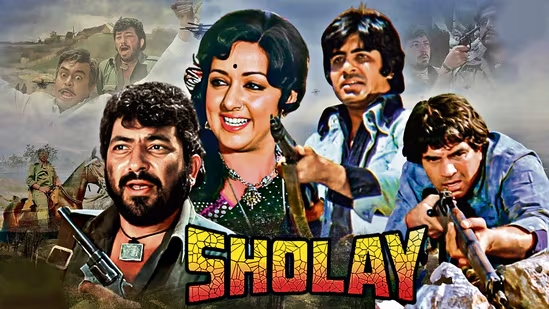
When Sholay Failed First and Won Forever
An NLP Lens on Rejection, Reframing, and Resilience
This week, Sholay returned to the big screen and something remarkable happened.
Audiences did not just watch the film.
They relived it.
Laughter erupted at familiar lines. Silence fell in scenes people already knew by heart. Applause broke out without prompting. It felt less like a re-release and more like a reunion.
Yet, rewind exactly 50 years to 1975.
Before Sholay became a super mega hit, before it turned into a cultural scripture quoted across generations, it faced strong criticism from reviewers. I recently revisited one such newspaper review from its original release, and reading it today is a fascinating psychological experience.
Because almost everything that was criticised then…
is exactly what made Sholay immortal.
Here is the review which actually criticised and even ridiculed the movie Sholay when it was released in 1975
https://w3coach.com/let-your-work-speak-for-you/
Let us look at this through an NLP lens. From an NLP perspective, Sholay offers a masterclass in how meaning is not fixed. Meaning is constructed.
The Map Is Not the Territory
One of NLP’s foundational principles is this: the map is not the territory.
Critics in 1975 were responding to their maps of what cinema should look like at that time. They were comparing Sholay to existing frames of reference. Song structures. Story arcs. Moral binaries. Duration norms.
But Sholay was not trying to fit an old map.
It was quietly creating a new territory.
Audiences sensed it before critics did. Over time, that new territory became the benchmark.
A powerful reminder for leaders, creators, and professionals: rejection often says more about the observer’s map than your actual territory.
Chunking and the Problem of Perspective
Many early reviews criticised Sholay for its length and episodic feel. From an NLP lens, this is a classic chunking mismatch.
At a micro level, the film felt indulgent.
At a macro level, it was mythic.
When you chunk up, Sholay is not just a story of two friends versus a villain. It is about loyalty, loss, moral ambiguity, fear, courage, humour in despair, and friendship that survives death.
Great work often fails when judged at the wrong level of chunking.
In organisations, I see this often. A long-term vision criticised for short-term discomfort. A leader labelled impractical because the observer is chunked too low.
Anchoring and Emotional Imprints
Today, the background score of Sholay is enough to trigger an emotional state. Gabbar’s dialogues have become anchors etched into collective memory. Jai’s silence. Veeru’s desperation. Thakur’s restraint.
But anchors do not always fire instantly.
Sometimes, the nervous system of a society needs time to wire new emotional associations. What feels unfamiliar today becomes iconic tomorrow.
This is true for ideas, brands, and identities.
If your work does not get instant validation, it does not mean it lacks impact. It may simply be ahead of the current emotional conditioning.
Reframing Failure as Feedback
NLP never treats failure as final. It treats it as feedback.
The initial criticism of Sholay did not erase the film. It refined the audience. Over time, people reframed what they were watching. What once felt excessive began to feel expansive.
The film did not change.
The frame did.
And that is perhaps the most liberating insight here.
You do not always need to change your content. Sometimes, the world just needs time to update its frame.
Fifty Years Later
Watching Sholay today, alongside that 1975 review, is a reminder that legacy is not decided in the first week, the first review, or the first response.
Legacy is decided by resonance over time.
And from an NLP lens, Sholay proves one timeless truth:
“Meaning is never fixed. It is constructed.”
And occasionally, history reframes what criticism could not.
That, perhaps, is Sholay’s greatest lesson beyond cinema.
A Lesson Beyond Cinema
Sholay is no longer just a film. It is proof that delayed recognition is still recognition. That criticism is not prophecy. That meaning evolves.
In NLP, we say: people respond to meaning, not reality.
In 1975, the meaning assigned to Sholay was limited.
In 2025, the meaning is legendary.
The difference was never the film.
The difference was the frame.
And that is the difference that truly makes the difference.
Image credit: Hindustan Times
Continue Your W3 Journey
The conversation doesn’t have to end here. Explore, reflect and continue your journey across Wealth, Wisdom and Wellness.
What’s Your W3 Quotient?
How balanced is your success across Wealth, Wisdom and Wellness?
Take a few minutes to discover your W3 Quotient. You may find that the results reveal something worth thinking about.
Never Miss a New Thought
Enjoyed this article?
Subscribe to W3 Coach and receive new articles, reflections and ideas directly in your inbox whenever they are published.
Discover the Magic in the Mundane
NLP is all around us, in our conversations, choices, behaviours and everyday experiences.
NLP Around You is my weekly exploration of these fascinating, often unnoticed patterns. Subscribe and receive each new edition directly in your inbox.
Outwardly Successful. Inwardly Stuck?
Sometimes, knowing what to do isn’t enough.
If you find yourself overthinking, procrastinating, reacting in ways you later regret, or repeating patterns you already know aren’t helping, join me for a free 90-minute live webinar:
OUTWARDLY SUCCESSFUL. INWARDLY STUCK?
The NLP Approach to Real Change
Discover what may really be happening beneath the patterns you want to change.
Discover more from W3 Coach
Subscribe to get the latest posts sent to your email.


Interesting